Article
SaaS Marketing Strategy: A Practical Guide to Demand Gen, PLG & Retention
Software buyers research for weeks before they ever talk to sales. Here's how SaaS companies actually build a marketing engine — from demand gen to product-led onboarding to retention — that shows up in CAC and MRR, not vanity metrics.
By Ranmi Sandalika · August 6, 2026
WHY SAAS MARKETING DOESN'T WORK LIKE A NORMAL MARKETING FUNNEL
Most B2B software buyers do their homework long before anyone from sales gets involved. They compare tools, read reviews, sign up for free trials, and only reach out once they've already narrowed the field down to two or three options. That changes what marketing actually has to do.
A SaaS marketing engine has three separate jobs, not one:
- Get you on the shortlist before the buyer starts comparing — this is demand generation.
- Get free or trial users to actually activate and pay — this is product-led growth (PLG).
- Keep the accounts you've already won from quietly churning out — this is lifecycle and retention marketing.
Most SaaS companies over-invest in the first job and almost ignore the other two, which is why a lot of "SaaS marketing" ends up looking like traffic with no revenue attached to it.
BUILDING THE DEMAND GENERATION LAYER
Demand gen for SaaS has to do two things at once: create interest where none exists yet, and capture the interest that's already searching.
Content and SEO that match buyer intent. Category and comparison content (this vs. that, alternatives to X, use-case pages) tends to convert better than generic "what is SaaS marketing" content, because it catches people later in their evaluation, closer to a decision.
Paid search and paid social tied to pipeline, not sign-ups. A campaign that's optimized for cheap sign-ups will happily fill your funnel with people who were never going to pay. Optimize toward qualified pipeline or trial activation instead, even if the headline sign-up number looks worse.
Retargeting for a long evaluation window. B2B software decisions often stretch across weeks or months and involve more than one person. Retargeting isn't about urgency — it's about staying visible while the buying committee finishes its research.
Account-based marketing for your highest-value targets. If a small number of accounts would move your revenue meaningfully, it's worth running targeted campaigns at those specific companies and the people inside them, rather than only competing in a broad, generic funnel.
Increasingly, a chunk of that early research isn't happening on a search results page at all — it's happening inside ChatGPT or Perplexity, where a buyer just asks the assistant to shortlist tools for them and only visits a website once it's already been recommended. Whether your content actually gets pulled into those answers comes down to answer engine and generative engine optimization, and it's becoming as important as ranking on page one of Google for the same keywords.
PRODUCT-LED GROWTH: WHERE MOST SAAS MARKETING BUDGET SHOULD ACTUALLY GO
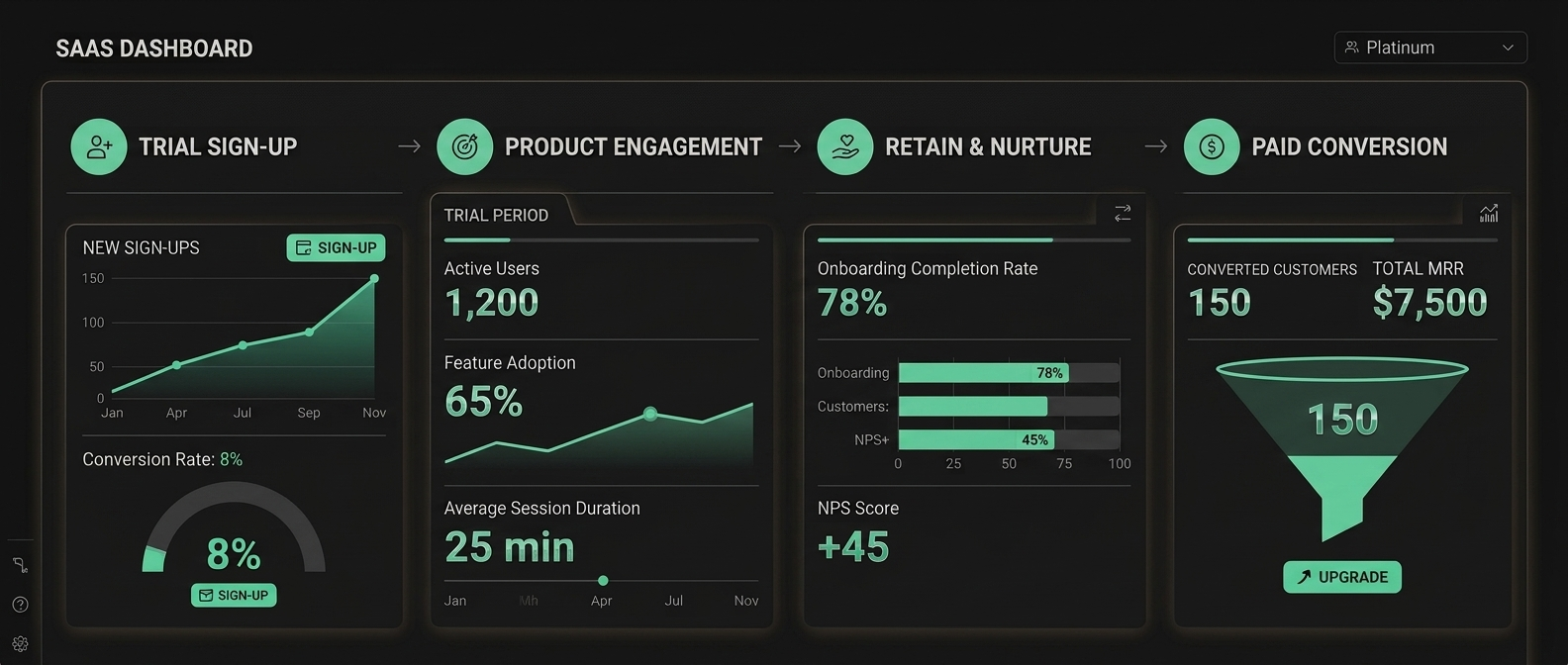
Getting someone into a free trial is the easy half. Getting them to activate, see value, and convert to paid is where most SaaS companies lose the deal — and it's a marketing problem as much as a product one.
Onboarding sequences built around activation, not sign-up. The goal of trial onboarding isn't "welcome to the product" — it's getting the user to the specific action that correlates with them becoming a paying customer, as fast as possible.
Behavior-based nurture instead of a generic drip sequence. A user who's logged in five times this week and one who signed up and never returned shouldn't be getting the same emails. Nurture built around actual usage data converts meaningfully better than a fixed day-1/day-3/day-7 sequence.
Expansion and upsell tied to account health. Growing existing accounts is usually cheaper than acquiring new ones. Campaigns that trigger off usage thresholds (seats, feature adoption, hitting a plan limit) outperform blanket upsell emails.
Churn-risk messaging before the cancellation, not after. By the time someone hits "cancel," it's almost always too late. Usage drop-off is a visible signal — the marketing should intervene while there's still something to save.
Almost all of this — the onboarding sequence, the usage-triggered nurture, the upsell trigger, the churn-risk win-back — actually gets delivered through email. It's easy to treat email as an afterthought once the ads and SEO are running, but for SaaS specifically, a properly built email marketing program tends to be the difference between a trial that converts and one that quietly goes cold.
WHAT TO ACTUALLY MEASURE
Sessions and traffic are easy to report and mostly meaningless on their own. For a SaaS business, the numbers that matter are:
- Pipeline created and cost per qualified lead
- Customer acquisition cost (CAC) and payback period
- Trial-to-paid conversion rate
- Net revenue retention (NRR) and churn rate
If a channel can't be tied back to one of these, it's worth questioning whether it deserves the budget it's getting.
COMMON MISTAKES SAAS COMPANIES MAKE WITH MARKETING
- Treating trial sign-ups as the finish line instead of the starting point
- Running SEO and paid in isolation instead of pointing both at the same high-intent keywords
- Sending every free-trial user the identical onboarding email, regardless of what they've actually done in the product
- Only reacting to churn instead of watching for the usage signals that predict it
- Reporting on traffic to leadership instead of CAC, payback period, and NRR
WHERE TO START
You don't need all four layers (demand gen, PLG, ABM, retention) running perfectly on day one. Most SaaS companies get the most immediate return by fixing the two furthest apart: trial-to-paid conversion (because it's usually the most fixable) and the top 2–3 keywords your actual buyers are searching for.
If you want a full breakdown of how this works for your specific product, our SaaS marketing service covers demand generation, PLG and retention in more detail — or get in touch and we can look at where your funnel is losing the most people.
Frequently asked questions
What's the difference between demand generation and product-led growth in SaaS marketing?
Demand generation is about getting the right people into your funnel — content, SEO, paid, and ABM aimed at people who might buy. Product-led growth is about what happens after they sign up: turning a free trial or free-plan user into a paying customer through onboarding, in-product nurture, and activation-focused messaging.
How quickly should a SaaS company expect results from marketing?
Paid channels can surface qualified pipeline within a few weeks once targeting is dialed in. SEO and content typically take three to six months to compound, but keep paying back well beyond that window — which is why most SaaS companies run both at once rather than choosing one.
What metrics should a SaaS company track instead of traffic?
Qualified pipeline, trial-to-paid conversion rate, customer acquisition cost, payback period, and net revenue retention. These map directly to whether the business is growing efficiently — traffic and sign-ups on their own don't.
Does product-led growth work for sales-led SaaS companies too?
Yes, though the emphasis shifts. Sales-led businesses use PLG principles for lead scoring and pipeline quality rather than pure self-serve conversion — the trial or demo still needs to show value fast, even if a rep closes the deal.