Article
Email Marketing vs SMS Marketing: Which One Should Get Your Budget?
Email marketing vs SMS marketing isn't a choice you have to make once and live with. Here's how to split budget and messaging between the two based on what each one is actually good at.
By Ranmi Sandalika · September 22, 2026
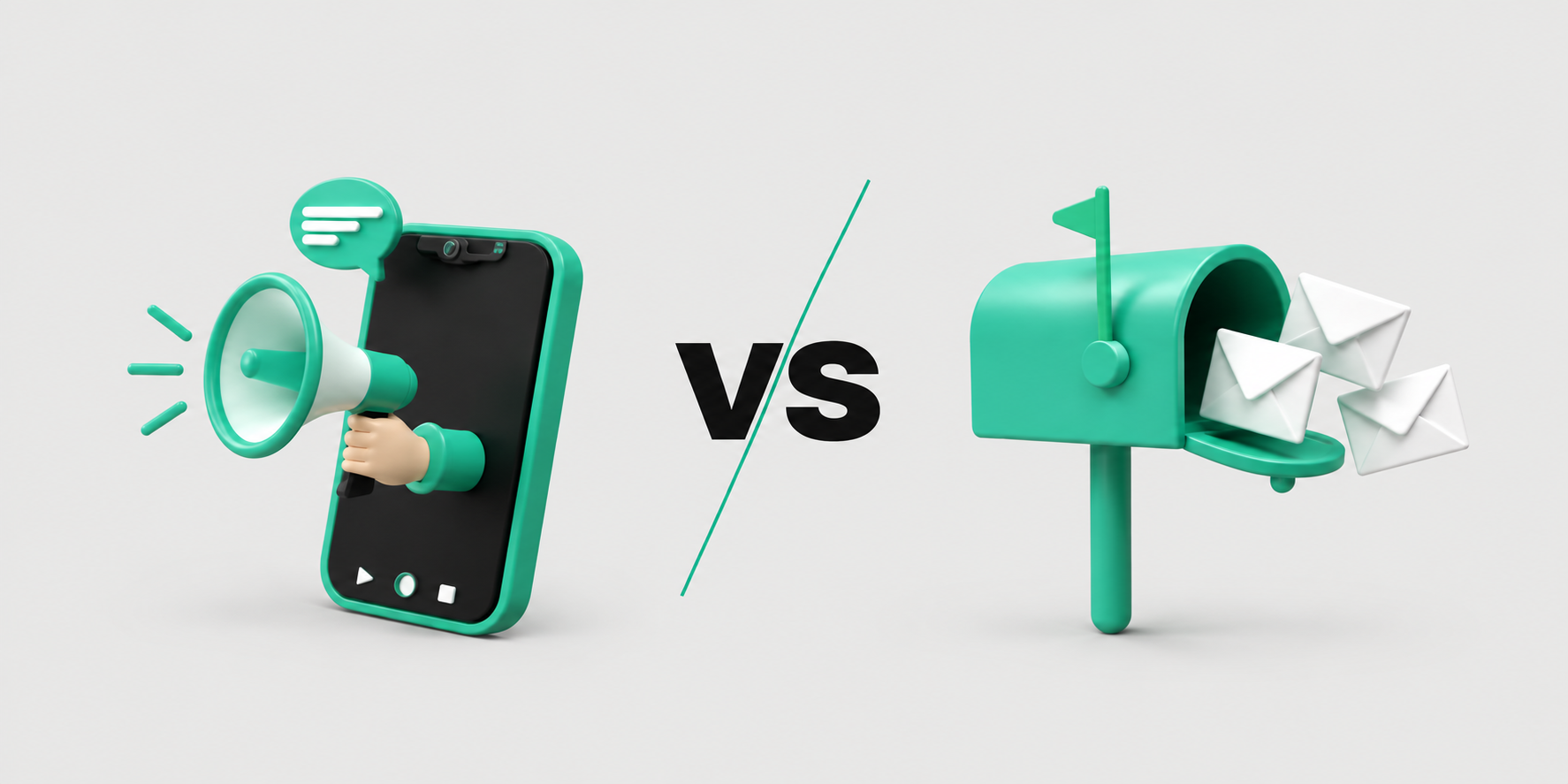
Email marketing vs SMS marketing usually gets framed as a choice, pick one and commit. That framing costs businesses money. The two channels solve different problems. The businesses getting the best return run both, deliberately, rather than defaulting to whichever one their platform set up first.
This post breaks down what each channel actually does well and where the other one falls short. It also covers how to split budget and messaging between them, so spend doesn't end up going toward the wrong channel for the wrong message.
Email marketing vs SMS marketing: the core differences
Email marketing wins on depth, cost, and reach. SMS marketing wins on speed and attention. Email can carry images, long copy, and multiple calls to action for a few cents per send. SMS costs more per message and demands brevity, but it gets opened within minutes, not days.
Neither one replaces the other, because they're built for different moments in the customer relationship. Email is where you build a case. SMS is where you get someone to act right now. Deciding between email marketing vs SMS marketing for a specific campaign really comes down to which of those two jobs the message is actually doing.
Measurement differs too, and that shapes how each channel gets judged internally. Email reporting typically tracks open rate, click rate, and revenue per send. That's enough volume to spot trends within a single campaign. SMS reporting leans more heavily on click-through and conversion, since open rate is close enough to universal that it stops being a useful signal on its own.
The practical differences that matter for budget decisions:
Cost per send. Email typically runs a fraction of a cent per contact through most platforms. SMS runs several cents per message, and pricing varies by country and carrier.
Content capacity. Email supports images, long-form copy, and several links. SMS caps out around 160 characters before it splits into multiple messages. That means the message has to stay short and singular.
Opt-in requirements. Both need consent. SMS compliance is stricter in most markets, with tighter rules around opt-out language and message frequency.
List size tolerance. Email lists can run into the hundreds of thousands without much friction. SMS lists usually stay smaller, because higher per-send cost forces more selective list-building.
A mid-sized retailer running both channels might have 80,000 email subscribers but only 12,000 SMS opt-ins. That gap is normal, and it reflects cost and consent friction, not a failure to grow the SMS list. The right benchmark for SMS growth is engagement quality, not raw subscriber count.
When email marketing wins on email open rates and reach
Email marketing is the better channel when the message needs room to make a case. A product launch, a newsletter, a nurture sequence: anything where context and detail change the outcome fits email. It's also the cheaper channel by a wide margin, which matters once a list grows past a few thousand contacts.
Email open rates vary a lot by industry, but a healthy list typically lands somewhere between 20% and 35%. That number looks weak next to SMS open rates, which often clear 90%, but email compensates with volume and cost. A campaign that only converts 2% of a 50,000-person list can still beat a smaller, pricier SMS send. Volume makes up the difference on total revenue.
Email also carries the weight of ongoing relationship-building. A weekly newsletter, a post-purchase sequence, a re-engagement campaign for lapsed customers: these all depend on the reader having time and space to absorb more than one line of text. That's not a job SMS was built to do.
When SMS marketing wins
SMS marketing wins the moment urgency matters more than detail. Flash sales, appointment reminders, shipping updates, and time-limited offers all convert better over text. The message gets read within minutes, rather than sitting in an inbox for a day or two.
Three scenarios where SMS consistently outperforms email:
Time-sensitive offers. A 24-hour flash sale loses most of its power in an email someone opens two days later. Over text, it lands while the deadline still means something.
Transactional updates. Shipping notifications, appointment confirmations, and delivery windows all benefit from the near-instant read rate SMS gets.
Re-engaging a cold contact. Someone who's stopped opening emails will often still read a text. There are simply fewer of them competing for attention.
The tradeoff is cost and tolerance. Send too many texts and unsubscribe rates climb fast, faster than they do on email. A text feels more personal and more intrusive when it's unwanted. That reaction shows up in the unsubscribe numbers quickly.
Building a marketing channel mix that uses both
The businesses getting the best results don't pick a winner in the email marketing vs SMS marketing debate. They build a marketing channel mix where each channel handles the job it's actually good at. Neither one gets asked to do the other's work.
A workable split looks like this:
Email carries the ongoing relationship: newsletters, nurture sequences, product education, and anything that benefits from detail.
SMS carries the urgent moments: cart abandonment reminders, flash sales, and transactional confirmations that need to be seen fast.
Both channels reinforce the same offer during a major campaign, with SMS driving urgency and email carrying the full pitch.
This same logic applies across paid channels too, not just owned ones. If you're also weighing where ad spend should go, our breakdown of Google Ads vs Facebook Ads covers the same kind of decision. It's the same channel-fit logic, just applied to paid budget instead.
Getting the split right takes testing, not guessing. Send frequency, message timing, and list segmentation all shift the numbers. What works for one industry rarely transfers cleanly to another. A channel mix built for a competitor's business often underperforms when copied directly, without adjusting for a different audience and product. If building and running that mix isn't something your team has bandwidth for, our email marketing service handles the strategy and cadence for both channels together. That keeps them reinforcing each other instead of competing for the same contact's attention.
Cost and compliance, in plain terms
Budget for SMS at roughly ten to twenty times the per-send cost of email. Plan list size and frequency accordingly. A large SMS list sent to daily will burn through budget fast and irritate contacts faster.
Compliance also deserves a real answer, not an afterthought. SMS requires explicit opt-in in most markets, along with clear opt-out instructions in every message. Email compliance (CAN-SPAM, GDPR, and similar regional rules) is more familiar territory for most marketing teams. SMS rules get enforced more aggressively, though, since carriers themselves can block a sender that racks up spam complaints. A blocked sender number can take days to restore. That's what makes SMS compliance worth getting right the first time, rather than fixing it after a problem shows up.
Two practical safeguards cover most of the risk:
Keep the opt-in separate from email sign-up. A visitor agreeing to receive emails hasn't agreed to receive texts. Bundling the two into one checkbox is a common shortcut. It creates real exposure if a regulator or carrier ever reviews it.
Build the opt-out instruction into every message, not just the first one. Most SMS platforms handle this automatically. It's still worth confirming, rather than assuming the default template covers it correctly for your market.
Where to start this quarter
Don't try to run a full SMS program on day one if the channel is new to your business. Start with one use case. Cart abandonment or appointment reminders tend to convert well and carry low risk. The results from that one use case will tell you whether a broader SMS strategy earns its cost.
Keep building the email side in parallel. It's the cheaper channel, and it's the one most businesses already have the infrastructure for. If the email marketing vs SMS marketing split in your current channel mix needs a second look, get in touch. We'll help map out where each channel fits in your specific customer journey.
Frequently asked questions
Is SMS marketing more effective than email marketing?
Neither is more effective across the board. SMS gets read faster and converts better for urgent, time-sensitive messages, while email costs less and carries more detail for ongoing relationship-building. The right channel depends on the message, not a fixed ranking between the two.
How much does SMS marketing cost compared to email?
SMS typically costs ten to twenty times more per message than email, depending on the platform and country. That higher cost is why most businesses use SMS selectively, for time-sensitive or high-value messages, rather than as a full replacement for email.
Can I use the same message for both email and SMS?
Not usually, and not well. Email supports detail, images, and multiple links, while SMS needs a single, short call to action. Repurposing an email verbatim into a text message almost always reads as too long and too vague for the format.
How many SMS messages can I send before people unsubscribe?
There's no universal number, but SMS unsubscribe rates climb faster than email's when frequency feels excessive. Most businesses that succeed with SMS cap sends at a few per month outside of transactional messages, and test upward carefully rather than starting at a high frequency.