Article
How to Generate Leads and Customers That Actually Convert
Most funnels stall right where it matters most — turning attention into revenue. Here's how to generate leads and customers without wasting spend on traffic that never converts.
By Ranmi Sandalika · August 15, 2026
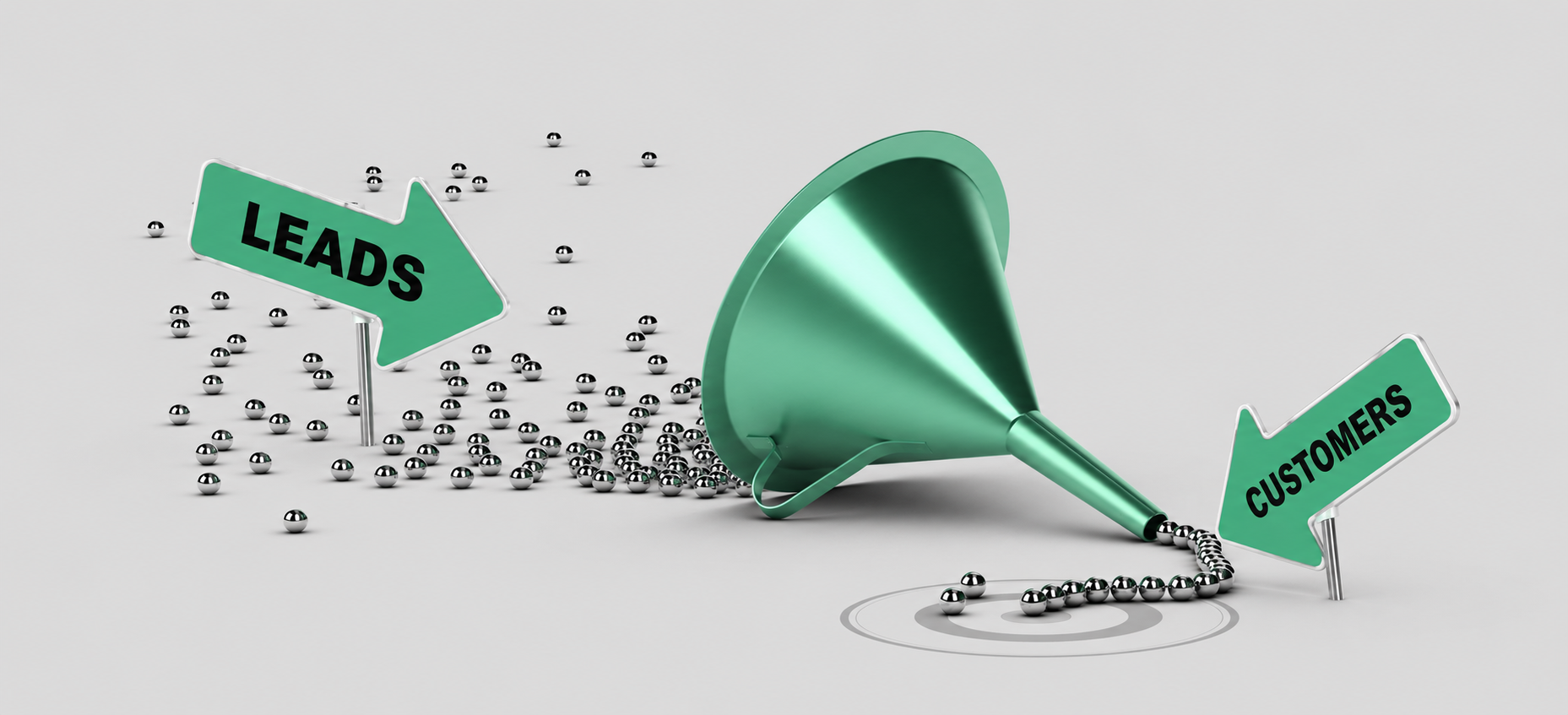
Awareness gets people to notice you. Consideration gets them to trust you. Neither one pays the bills. At some point, a prospect becomes a lead. Then a lead becomes a customer. That's where you generate leads and customers — and it's also where most funnels quietly leak revenue.
You already know the symptoms. Traffic looks healthy. Impressions are up. Then the pipeline report tells a different story. Cost per lead is climbing. Sales is complaining about lead quality. The CRM is full of contacts who never book a call. That's not a top-of-funnel problem. It's what happens when you generate leads and customers using the wrong mechanics for the stage they're actually in.
This is where we focus once awareness and trust are already built. Here's how to optimise the leads-and-customers stage of the funnel, and what to check first if yours isn't converting.
Why lead volume isn't the metric that matters
A lead count going up looks like progress. It's often the opposite. If the definition of "lead" is loose, you're rewarding volume over fit. A form fill, a newsletter signup, a click on a retargeting ad — none of that guarantees intent. Sales ends up chasing contacts who were never going to buy.
The fix starts before a single ad runs. Define what a sales-qualified lead actually looks like for your business, in revenue terms. Budget, authority, timeline, and a real problem you solve. Every campaign, page, and automation downstream should be built to filter for that definition, not just fill a spreadsheet.
High-intent performance ads engineered for ROAS, not vanity metrics
Most Google and Meta accounts are still optimised for clicks and impressions because those numbers are easy to report on. They're also disconnected from revenue. A campaign can hit every awareness benchmark and still lose money.
Build high-intent performance ads around the actions that predict revenue, not the ones that predict engagement:
Bid and target on conversion events, not clicks. Feed the platform real sales data — booked calls, closed deals, order value. It finds more people who convert, not more people who click.
Match ad intent to funnel stage. Someone searching a solution-specific term is ready to buy. Someone who saw a brand-awareness video three weeks ago isn't. Running the same offer at both is how budget gets wasted.
Kill underperforming segments fast. A two-week lookback on cost-per-qualified-lead, not cost-per-click, tells you which audiences are worth scaling and which are quietly draining spend.
Done right, this is the mechanism that lets you generate leads and customers from paid channels. See how we structure performance ad accounts without inflating the top-line lead count while starving the pipeline that actually closes.
Landing pages and conversion rate optimisation: where traffic converts or leaves
Even a perfectly targeted campaign fails if it lands on a page built for browsing instead of converting. This is the part of the funnel most businesses under-invest in. It doesn't feel as exciting as launching a new campaign, but it's usually the highest-leverage fix available.
Conversion rate optimisation isn't a redesign. It's a set of specific, testable decisions:
One offer per page, one action per visitor. A page trying to sell three services at once dilutes intent and drops conversion across all three.
Remove friction before adding persuasion. Fewer form fields, faster load times, and a clear next step usually beat another testimonial block.
Match the page to the ad that sent the click. If the ad promises a specific outcome, the landing page headline should restate it in the first five words visible. Not a generic company tagline.
This is also where website development and CRO work together. A fast, well-structured site gives every other funnel tactic something worth sending traffic to. A landing page that turns clicks into booked appointments is worth more than a 20% increase in ad spend. It's usually cheaper to build, too.
Marketing automation: getting the right lead to the right rep, fast
A qualified lead that sits in an inbox for two days is a lead you paid for twice. Once to generate it. Once, if you're lucky, to win it back before a competitor calls first. Speed to lead is one of the most underrated levers in the entire funnel. It's also almost entirely solvable with automation.
Marketing automation should be doing three things without a human touching it:
Score leads on fit and intent, not just activity. A pricing-page visit from a target-industry company should route differently than a blog read from an unrelated persona.
Route the highest-fit leads to sales immediately. Every hour of delay measurably lowers contact and close rates — automation removes the delay entirely.
Nurture everyone else without manual follow-up. Leads who aren't sales-ready yet still deserve a sequence that keeps them warm until they are. That beats letting them fall out of the funnel.
This is where lead generation stops being a marketing metric and starts being a revenue system. It hands sales exactly who to call and why, instead of a list to sort through.
How to generate leads and customers at every stage of the funnel
Performance ads, CRO, and automation aren't three separate projects. They're one system, and each piece only works as well as the ones around it. Great ads sending traffic to a weak landing page waste spend. A strong landing page with no automation behind it lets qualified leads go cold. That's the real argument for treating the funnel as a single pipeline with one owner. Not a set of disconnected tactics run by different teams on different timelines.
It's also why we built our own pay-per-lead model around this exact stage. When the ad, the page, and the follow-up are engineered together, you can price on the outcome that matters. A lead that converts.
Where to start
If awareness and consideration are already handled, the next audit is simple. Pull your last 90 days of leads and check three numbers. Cost per sales-qualified lead, not cost per lead. Average speed to first contact. And landing page conversion rate by traffic source. Whichever one is worst is where the leak is.
Fixing that one number usually moves more revenue than adding another campaign on top of a broken funnel. If you want a second set of eyes on where yours is leaking, get in touch. We'll show you exactly where.
Frequently asked questions
What's the difference between a lead and a sales-qualified lead?
A lead is anyone who gives you contact information. A sales-qualified lead has budget, authority, a timeline, and a problem you actually solve. Tracking the first number instead of the second is the most common reason funnels look healthy but don't close revenue.
How fast should a sales-qualified lead be contacted?
As close to immediately as possible. Contact and close rates both drop sharply after the first hour. That's why routing and follow-up are usually automated, rather than left to a rep checking their inbox between calls.
Should landing pages be built for cold traffic or paid traffic?
Build separate pages for each. Cold, top-of-funnel traffic needs more context and trust-building. Paid, high-intent traffic converts better on a page built around one specific offer. Keep friction between the click and the action to a minimum.
How do we know if performance ads are actually working?
Cost per click and impressions don't answer that question — cost per sales-qualified lead and return on ad spend do. If a campaign report only shows the first two, ask for the second two before deciding whether to scale it.